ATLAS / CAPABILITY
Backend & API integration
Data models, authorization, business rules and external services. Transactions should remain consistent through failures and retries, not only successful requests.
What need does this address?
Data models, authorization, business rules and external services. Transactions should remain consistent through failures and retries, not only successful requests. We start with how the work happens today, where time is lost and what users need to complete. The problem definition comes before a list of tools.
How do we define scope?
We identify existing systems, content, data sources and decision owners. The priority journey, boundaries of the first release and deferred requirements are recorded. Integration access and third-party costs are evaluated separately.
Designing both sides of an integration
An API integration is more than reading a successful response. Expired authorization, a slow provider, unexpected payloads and repeated notifications all require defined behaviour. We identify who owns each field and which record is authoritative before implementation.
For example, a system receiving external order updates should not assume notifications arrive in order. Its data model must avoid reverting to an older state, apply work once and retain failed events for investigation. Secrets do not belong in the browser, authorization is enforced on the server and operational logs should not collect unnecessary personal information.
Database changes require their own delivery plan: backup, validation, rollback and compatibility with existing records. The operating team needs health checks, error visibility and replay instructions in addition to source code. Technology choices follow volume and consistency requirements rather than forcing every integration into one architecture.
What is checked before delivery?
Core deliverables for this service: Data integrity, Authorization, Webhook/API connections, Recovery and testing. Alongside normal use, we check missing data, invalid input and interrupted operations. A feature being visible and actually working are separate acceptance criteria.
After the initial delivery
Source code, access, setup and version information are documented as part of delivery. Maintenance, content updates and new features have a separately agreed scope. Time and pricing are not promised before discovery.
Common questions
Can this work with my existing system?
We first review data, APIs and access in the existing system, then compare integration and rebuilding against scope and maintenance effort.
How are timeline and pricing determined?
The proposal follows clarification of workflows, content readiness, integrations and acceptance criteria. Third-party service costs are identified separately.
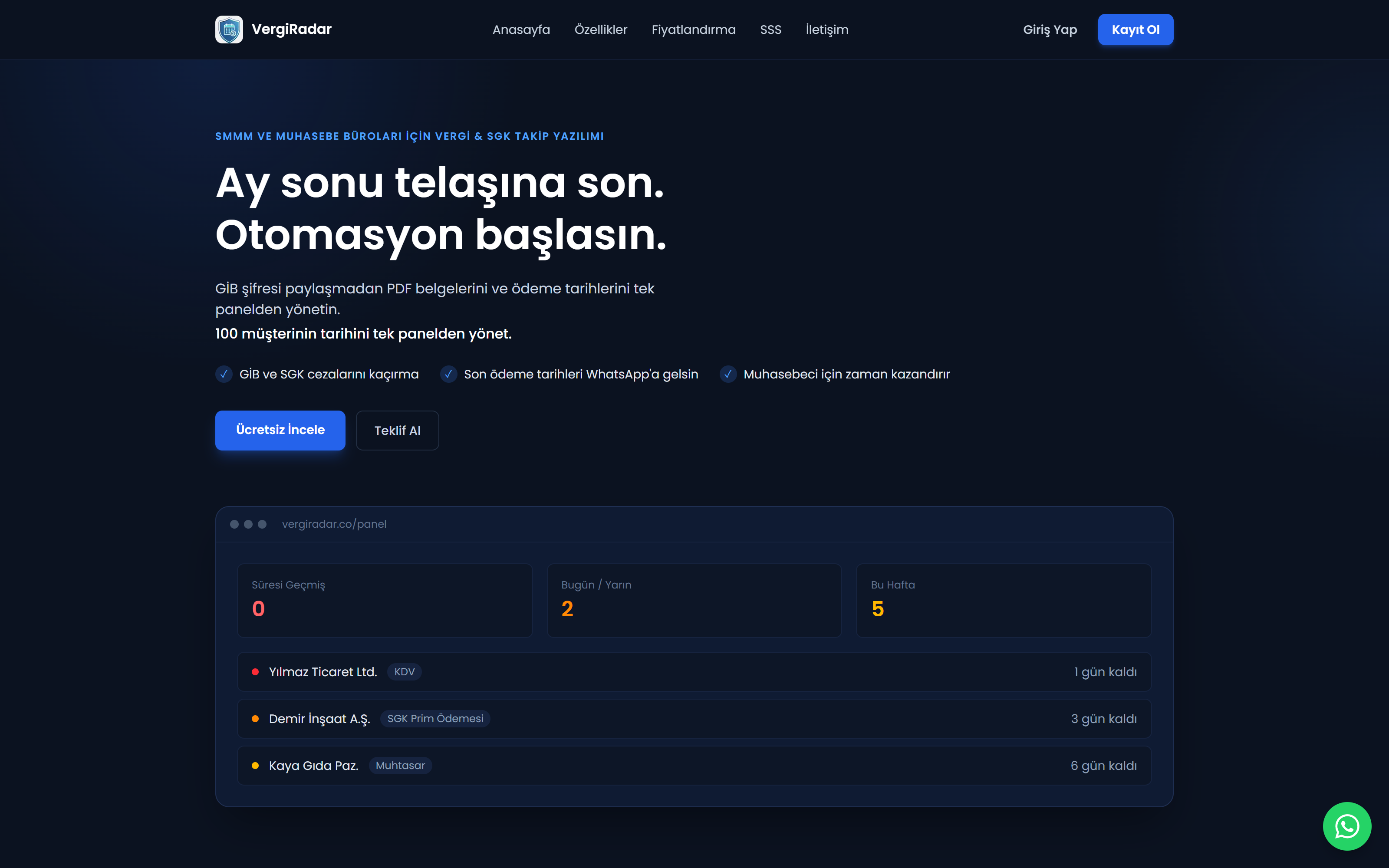
VergiRadar
Explore the scope and approach.
↗