ATLAS / CAPABILITY
SaaS & platform development
Web applications connecting users, roles, plans and business rules. Clear architecture from the first release through subsequent iterations.
What need does this address?
Web applications connecting users, roles, plans and business rules. Clear architecture from the first release through subsequent iterations. We start with how the work happens today, where time is lost and what users need to complete. The problem definition comes before a list of tools.
How do we define scope?
We identify existing systems, content, data sources and decision owners. The priority journey, boundaries of the first release and deferred requirements are recorded. Integration access and third-party costs are evaluated separately.
Membership is more than a screen
For a subscription product, we first map the relationship between a user, workspace and account owner. Multiple employees, misdirected invitations, departing colleagues and transferred ownership are distinct decisions. A polished dashboard cannot compensate for an undefined business model.
Consider a platform where customers invite their teams. We define acceptance scenarios for expired invitations, inviting an existing member and preventing access to another account's records. Plan entitlements must be enforced by the API, not merely hidden in the interface. When payments are in scope, provider notifications, repeated events and access after cancellation are examined separately.
You do not need a technical specification for the first conversation. Who uses the product, how they complete the task today and what might justify payment are useful starting points. We also document what is deliberately outside the first release. New ideas can then be assessed without silently changing the agreed delivery. Production readiness includes authorization, data integrity, error visibility and recovery; a visual approval alone is not enough.
What is checked before delivery?
Core deliverables for this service: Account and role model, Subscriptions and entitlements, Management interface, Testing and delivery. Alongside normal use, we check missing data, invalid input and interrupted operations. A feature being visible and actually working are separate acceptance criteria.
After the initial delivery
Source code, access, setup and version information are documented as part of delivery. Maintenance, content updates and new features have a separately agreed scope. Time and pricing are not promised before discovery.
Common questions
Can this work with my existing system?
We first review data, APIs and access in the existing system, then compare integration and rebuilding against scope and maintenance effort.
How are timeline and pricing determined?
The proposal follows clarification of workflows, content readiness, integrations and acceptance criteria. Third-party service costs are identified separately.
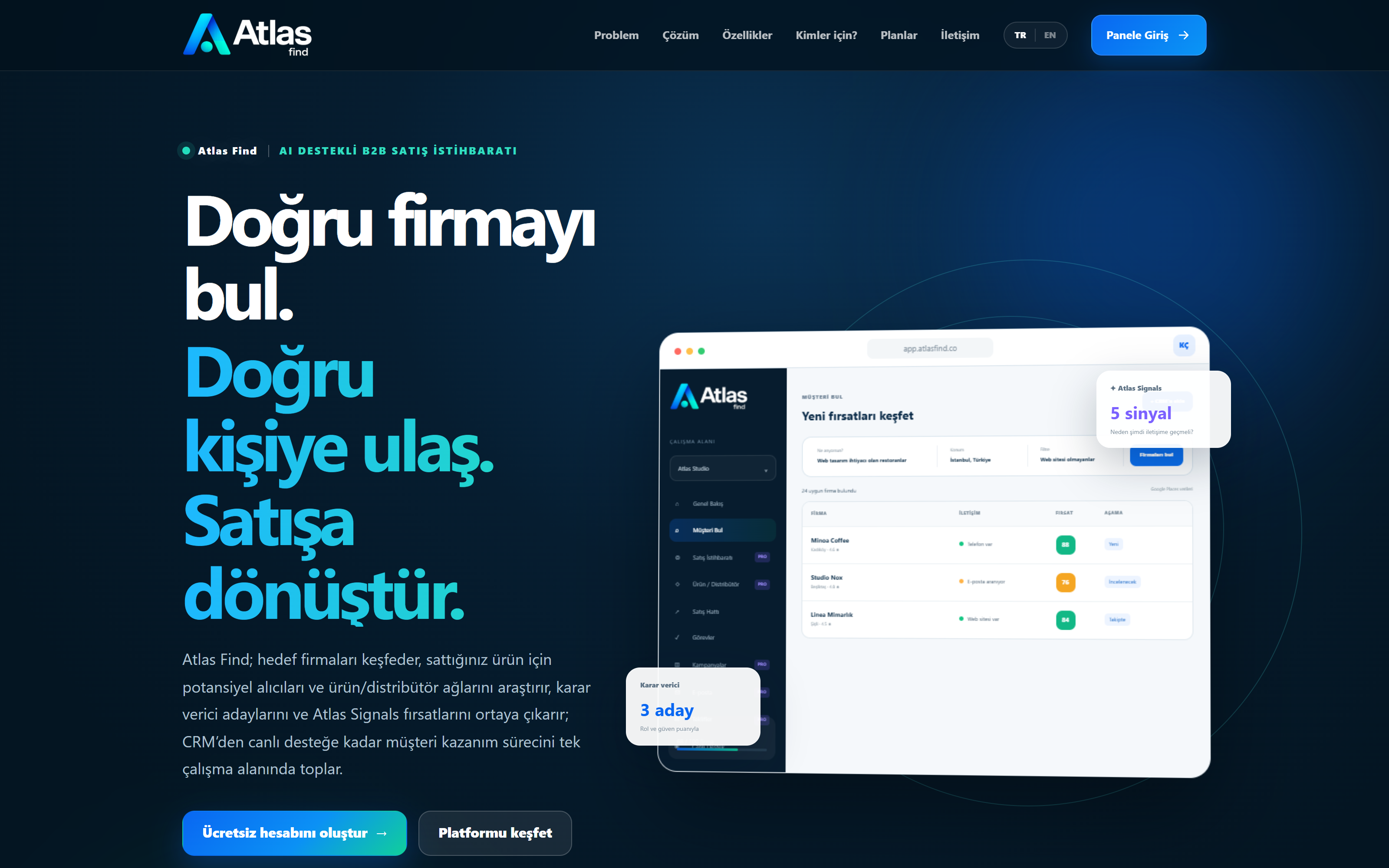
Atlas Find
Explore the scope and approach.
↗